
ESTECO’s Summer 2026 product update brings together the key capabilities and enhancements introduced across VOLTA, modeFRONTIER, and nDAI over the past quarter. Data Manager in VOLTA now opens collaboration at enterprise scale. myRSM enables you to develop custom RSM training algorithms and deploy them in modeFRONTIER.
nDAI adds support for 1- or 3-component fields as inputs in the nD Modeler app.
Product update highlights
VOLTA: enhanced collaboration in the Data Manager
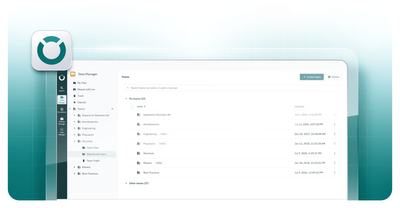
Data Manager’s Visible Teams enables open collaboration at enterprise scale. VOLTA’s Teams are now discoverable across the organization. People can find the right user or group, see its purpose, and connect quickly. This turns isolated, siloed workspaces into a connected environment where knowledge flows.
Collaboration now works in every direction: VOLTA’s Teams can share items with one another, share items with individual users, and receive items shared by users. Throughout, access stays controlled by role-based permissions, so the right people see the right information. And because data remain an organizational asset, knowledge is protected, reusable, and available to teams across the company.
VOLTA: introducing whiteboard shapes in BPMN Modeler
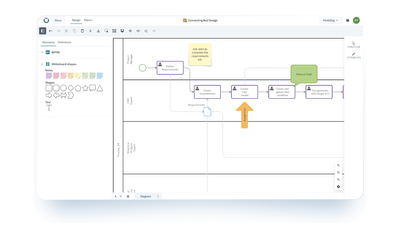
Whiteboard shapes, including sticky notes, geometric shapes, and text shapes, provide a flexible set of visual tools for annotating, organizing, and collaborating directly on your BPMN diagrams. They make it easier to add context, highlight important details, and structure ideas visually during the modeling of the business process workflow.
VOLTA: output domain configuration available in Planner
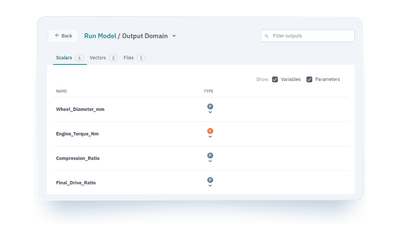
DOE and optimization studies can generate many outputs. The new Output Domain module lets you choose which output attachments are stored in the session table (designs generated during a simulation run). This makes results easier to review, and reduces time spent managing irrelevant data.
modeFRONTIER: introducing myRSM Python-based plugin framework
With myRSM, custom code becomes a modular, plug-and-play component. It enables you to deploy a RSM algorithm by simply importing it to modeFRONTIER, appearing as native options in the user interface.
- Native interface customization: developers can expose custom algorithm parameters directly in the modeFRONTIER interface, allowing users to configure them without editing Python code.
- Zero-maintenance deployment: myRSM works as a black box, eliminating the need to adapt scripts to local environment settings.
- Data protection: user training data is not embedded in the RSM models, reducing storage footprint and helping protect sensitive information.
nDAI: support for 1- or 3 component fields as inputs
You can now select 1- or 3 component inputs directly during model training in the nD Modeler app.
- 1-component inputs: use a single 1D signal from a CSV file, or a variable extracted from a VTU file, as a model input. These inputs are also included in the encoding step, so the model can process them properly as part of training.
- 3-component inputs: group three input parameters into a single vector variable (such as 3D mesh coordinates), allowing them to be treated as a single entity during model training. This enables training on non-parametric datasets or mixing datasets that do not share a common parametrization.
nDAI: support for Ansys RST files
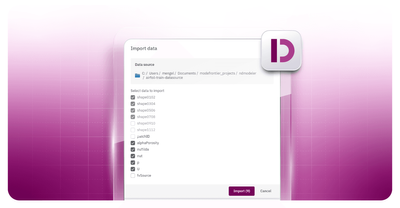
With nD Modeler, you can now import datasets stored in Ansys structural result files (RST), in the same way you would import VTU files. This streamlines the user experience and eliminates the proliferation of intermediate files.
nDAI: multi-language support
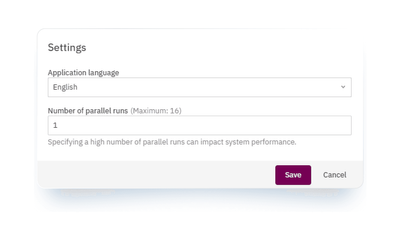
You can choose the application language in the Settings dialog box of the nD Modeler interface. The options (available also in VOLTA and modeFRONTIER software) are English, Japanese, and Chinese (simplified).
For additional new features, please refer to the what’s new section included in the software updates.
Interested in knowing more about the new features? Contact us.